Project
/
Melo
Exploring Sound as a Design System
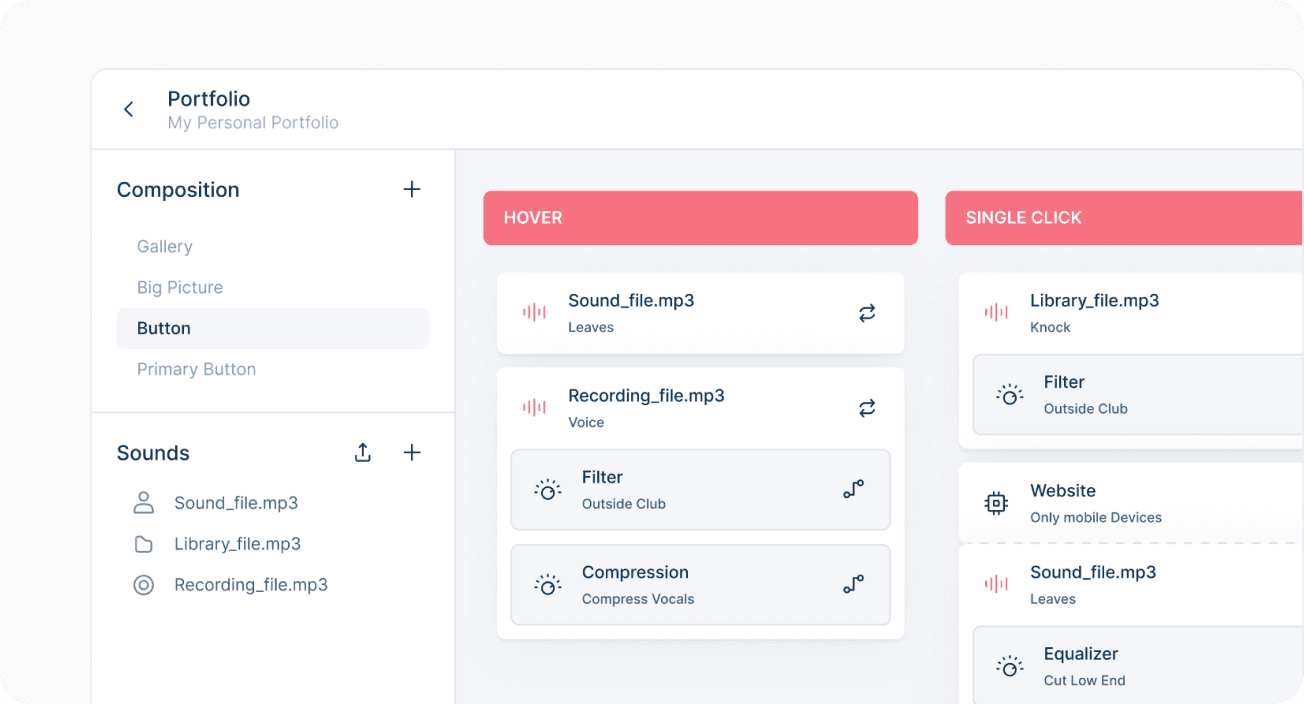
Manage, edit & distribute your sound experience - Melo is a platform that allows you to create and share your sound experiences.
Type
Case-Study
Role
UI/UX Design & Frontend Prototypes
Year
2021
What This Is (and What It Isn’t)
Melo is an exploratory case study.
It is not a shipped product, but a structured investigation into how sound could be treated as a first-class design concern rather than an implementation detail.
The work sits at the intersection of interaction design, system thinking, and tooling design. The goal was to explore concepts, not to validate a market or build production software.
Motivation
Sound plays a critical role in how digital interfaces feel — feedback, confirmation, error states, and ambience all rely on it. Yet in most products, sound decisions are made late, are hardcoded, or live entirely in engineers’ heads.
What interested me was not “how to add sound”, but:
- how sound decisions are communicated
- how intent gets lost between design and implementation
- and why sound is rarely designed with the same rigor as visual systems
This case study asks a simple question:
What if sound was designed like a system, not like an asset?
Framing the Problem
In most teams:
- designers talk about sound abstractly (“subtle”, “playful”, “serious”)
- engineers need concrete parameters and constraints
- product teams want consistency and predictability
There is no shared interface or model that connects these perspectives. Sound becomes either:
- overly flexible and chaotic
- or overly rigid and underutilized
The core tension explored here is:
How can sound be expressive without becoming unmanageable?
Exploration & Approach
Treating Sound as Behavior
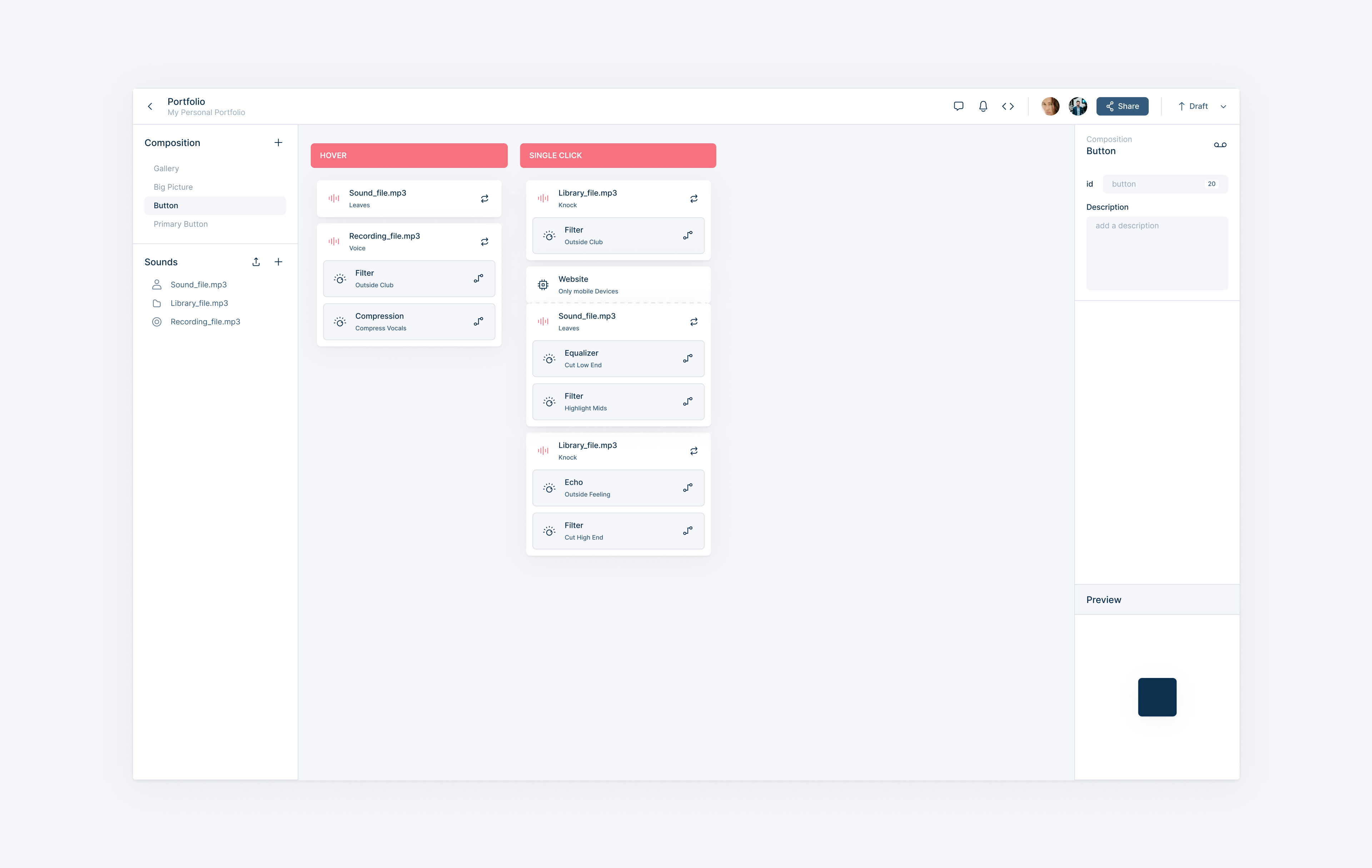
Instead of thinking in terms of audio files, sound is reframed as behavior tied to events and states:
- confirmations
- transitions
- errors
- background states
- attention cues
This shift makes it possible to think about sound in the same way we think about interaction patterns.
Designing for Intent, Not Parameters
Rather than exposing raw technical controls, the exploration focuses on:
- intent-driven configuration
- constrained choices over infinite flexibility
- sensible defaults that communicate meaning
The interface concepts deliberately avoid traditional “audio tooling” metaphors and instead borrow from familiar UI system patterns.
Personas as Constraints
Lightweight personas were used not to simulate users, but to create design constraints:
- someone who cares about experience but not audio engineering
- someone who needs predictable, testable behavior
- someone responsible for consistency across surfaces
Each concept was evaluated through these lenses.
Outcomes
The result of this exploration is a set of interaction concepts that:
- demonstrate how sound could be configured alongside UI
- surface trade-offs between flexibility and control
- create a shared language between design and engineering
- make sound decisions inspectable rather than implicit
The value of the work lies in:
- the framing of the problem
- the abstractions explored
- and the design patterns proposed
—not in feature completeness or production readiness.
Reflections
Two insights stood out during this work:
-
Invisible systems need the strongest abstractions
The less visible an interaction is, the more intentional its design must be. -
Constraints are a UX feature
Removing options often increases clarity, trust, and consistency — especially in system-level design.
This way of thinking later informed my work on agent UX and change tracking, where the same pattern repeats: users don’t just need power, they need legibility.
Technical Architecture (Schematic)
schematic[Custom Frontend] | user interactions (click / hover / scroll) v [npm sound-behavior library] | maps UI events to sound behaviors | pulls intent + config from API v [Next.js app — sound store & orchestration] | manages presets, assets, rules, telemetry | exposes routes for config + playback instructions v [Sound assets + behavior graph]
Why This Case Study Still Matters
Melo represents how I approach ambiguous problems:
- start with framing, not solutions
- design systems before interfaces
- and use constraints as a design tool
Even though this was not a product, the thinking behind it directly applies to complex, real-world systems — especially those involving automation, AI, or collaboration.